
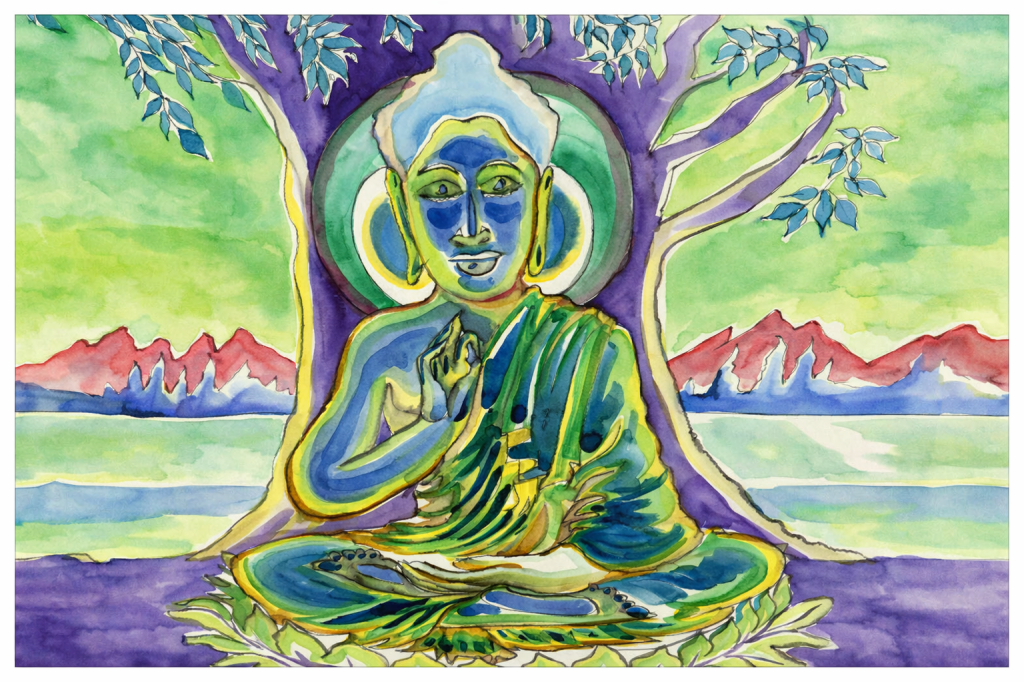
Śākyamuni Buddha — known in the sutras as the World-Honored One — was born Siddhartha Gautama, crown prince of King Śuddhodana of Kapilavastu, into the Śākya clan of ancient northern India. His mother was Queen Maya, and his birthplace Lumbini Grove, in present-day Nepal.
At the time of Prince Siddhartha’s birth, a fortune-teller predicted: “If he renounces the world to cultivate the Way, he will certainly become a Buddha; if he remains in the world, he will become a wheel-turning monarch.” During that period, religious thought in India had grown extreme, and kingdoms were constantly at war. People longed for benevolent governance and peace, while also seeking true liberation from the sufferings of existence. It was into this world that the World-Honored One was born.
In his adult years, Siddhartha married Yaśodharā and had a son named Rāhula, living a life of luxury and splendor. While traveling outside the palace, he witnessed the suffering of farmers, creatures preying upon one another, and the sufferings of old age, sickness, and death. Deeply moved by the impermanence of the world, he resolved to seek the truth and find a way to liberate all beings from suffering.
At the age of twenty-nine, Siddhartha resolutely renounced his royal life and left the palace to pursue the path of renunciation and cultivation. He first studied meditation, then underwent six years of ascetic practice — yet was unable to attain true liberation. He came to understand that neither sensual indulgence nor extreme asceticism was the correct path, and abandoned both extremes, turning instead to the Middle Way.
Siddhartha then sat in meditation beneath the Bodhi tree at Bodh Gaya, deeply contemplating the arising and ceasing of all phenomena in the universe. At last, he fully awakened to the principle of dependent origination and realized supreme, perfect enlightenment — becoming the Buddha. After his enlightenment, the World-Honored One spent forty-five years wandering and teaching throughout the Ganges River basin, sharing the Dharma of the Middle Way, compassion, and equality, guiding all beings toward liberation from suffering and the attainment of true happiness.
The term “Buddha” means an awakened one who has perfected both enlightenment and conduct. The Buddha is neither a god nor a messenger of God, but a noble one who, through cultivation in the human realm, attained ultimate awakening. The Dharma he revealed continues to inspire countless people in their pursuit of wisdom, compassion, and inner liberation. In his later years, the World-Honored One entered parinirvāṇa at Kushinagar. His teachings continue to reach and transform hearts throughout the world to this day.
In addition to the word “Buddha,” there are numerous epithets that we hold dear to our hearts. Each points toward a distinct facet of his complete awakening:
Tathāgata (Thus Come One) — One who has come in accordance with the principle of ultimate reality and likewise departs in truth; one who fully understands the reality of the universe and human life.
Arhat (Worthy of Offerings) — One who has eliminated all afflictions and is worthy of offerings from both humans and celestial beings.
Samyak-saṃbuddha (Perfectly and Universally Enlightened One) — One who correctly and universally awakens to all phenomena.
Vidyā-caraṇa-saṃpanna (Perfect in Wisdom and Conduct) — One whose wisdom and cultivation are complete and perfect.
Sugata (Well-Gone) — One who has skillfully transcended the sea of suffering.
Lokavid (Knower of the World) — One who thoroughly understands the truths of the world.
Anuttarā (Unsurpassed One) — One whose virtue and wisdom are supreme, with no one above.
Purusadamya-sāratha (Tamer of Beings) — One who skillfully guides sentient beings toward liberation.
Śāstā devamanuṣyānām (Teacher of Gods and Humans) — The great teacher of both celestial beings and humankind.
Buddho bhagavān (World-Honored One) — The most venerable and honored one in all the worlds.
These ten epithets represent the Buddha’s perfect accomplishment in virtue and wisdom, and his complete benefit to both himself and all others. They describe the qualities of his enlightenment and serve as a foundation for practitioners to recollect and praise the Tathāgata.
This July, relics of Śākyamuni Buddha travel from the Master Taixu Relic Stupa at Triple Wisdom Hall in Penang, Malaysia to Chicago’s Chinatown. Next week, we turn to the lives of two of his greatest disciples — the Venerable Śāriputra and the Venerable Maudgalyāyana — whose relics will also be present at the ceremony.
The Buddha and Sacred Relics Veneration and Prayer Ceremony takes place July 25–26, 2026 in Chicago’s Chinatown. The sacred relics will be open for public veneration throughout both days. All are warmly welcome.
For official event details, visit ibfachicagotemple.org. To receive updates as the ceremony approaches, sign up here.
 IBFA Chicago | International Buddhism Friendship Association
Leave a comment