
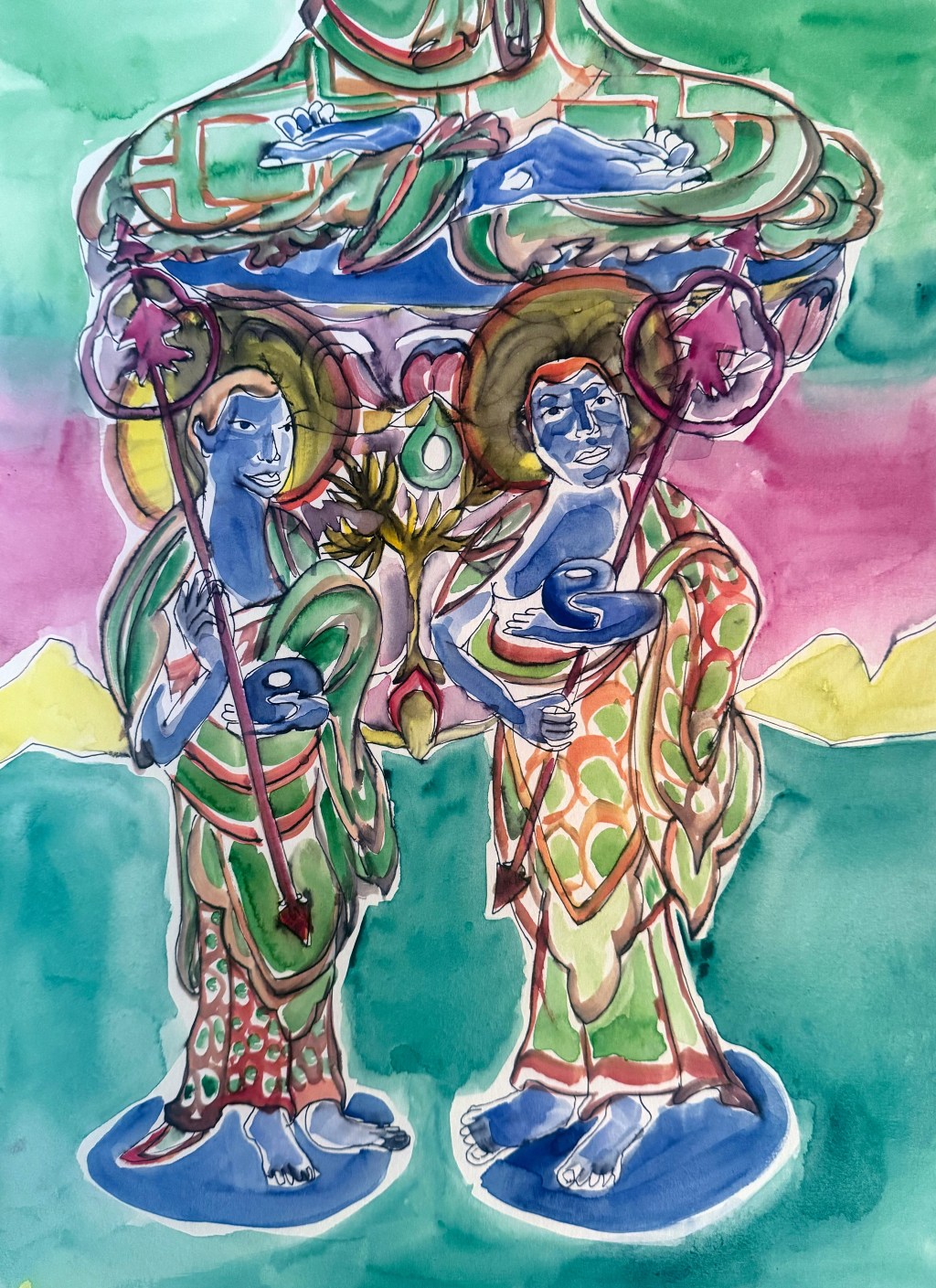
Among all the disciples of Śākyamuni Buddha, two names stand above the rest as the Buddha’s closest and most trusted: the Venerable Śāriputra and the Venerable Maudgalyāyana. The Buddha himself described them as his two wings — each indispensable to the other. Their relics are among the five traveling to Chicago this July.
Śāriputra and Maudgalyāyana were close friends from childhood, both born into wealthy Brahmin families near Rājagṛha. Attending a festival together, they were struck by a sudden, shared sense of life’s impermanence — the crowds, the celebration, all of it passing — and agreed then to renounce the world together in search of the deathless Dharma.
The turning point came when Śāriputra encountered the Buddha’s disciple Venerable Aśvajit on the street. Struck by Aśvajit’s serene and dignified bearing, he approached and asked about his teacher’s path. What he heard in reply was the verse on dependent origination:
“All phenomena arise from causes and conditions, and all phenomena cease by causes and conditions; the great sage, our Buddha, constantly teaches thus.”
Śāriputra immediately attained stream-entry — the first stage of awakening marked by breaking through the belief in the self. He brought the verse to Maudgalyāyana, who upon hearing it realized the same attainment. Together, they led their respective two hundred and fifty disciples to take refuge under the Buddha, and were ordained.
From there, their paths diverged in role even as they remained, as the Buddha said, two wings of a single bird.
Venerable Śāriputra — Foremost in Wisdom
Śāriputra’s name draws from śārī, the bird his mother resembled — a word that also echoes śarīra, the term for relics themselves, and carries within it the profound transcendent wisdom, prajñā, for which he was foremost among the Buddha’s disciples.
From childhood, Śāriputra was exceptionally gifted — at eight he could expound teachings, and by sixteen his eloquence was unsurpassed. Within the sangha, he served as chief trainer, teaching disciples to deeply understand the Dharma and caring for the spiritual life of newcomers with the tenderness of a loving mother. Thus, he was honored as the General of the Dharma for his role in guiding the sangha’s training.
When Śāriputra sensed his own death drawing near, a short time before the Buddha’s own final nirvāṇa, he asked for and received the Buddha’s permission to return to his homeland and teach the Dharma to his mother as one last act of filial piety. It was here that the Venerable Śāriputra attained final nirvāṇa.
Venerable Maudgalyāyana — Foremost in Spiritual Powers
Where Śāriputra guided the inner cultivation of disciples with maternal care, Maudgalyāyana served as great Dharma protector — using his exceptional spiritual powers to subdue those who opposed the Dharma and to aid beings in suffering, guiding the outward conduct of the sangha with the firmness of a stern father. Wisdom and power; mother and father; two wings of the same bird.
The Buddha’s description of their complementarity is borne out in the sutras: whenever profound philosophical questions arose, Maudgalyāyana would quietly step back and allow Śāriputra to speak — a gesture of deep respect and clear understanding of each other’s gifts.
The end of Maudgalyāyana’s life was both legendary and sobering. Due to karmic remnants from past lives, he was killed by non-Buddhist ascetics, crushed to death by rocks, not long after Śāriputra’s own passing. His death confirmed the teaching he had spent his life demonstrating: spiritual powers cannot overcome karma. Through the destruction of his physical body, Maudgalyāyana taught all future generations the true and unfailing nature of karmic cause and effect — that no power, however extraordinary, can circumvent what has been set in motion by past actions.
Two Branches of a Great Tree
Not long after both had attained final nibbāna, the Buddha sat in the open with the assembly of monks at Ukkacelā, on the bank of the Ganges. Surveying the silent gathering, he told them that this assembly seemed empty to him now that Śāriputra and Maudgalyāyana had passed — though for himself, he said, there was no true emptiness, since he held no concern for any region where the two of them had dwelled. No future pair of chief disciples, he told the monks, would ever surpass what Śāriputra and Maudgalyāyana had been to him.
He likened their passing to a great, sound tree losing its two largest branches — the trunk still standing, but visibly changed by what had fallen away. All that is born, formed, and conditioned, he reminded the assembly, is subject to passing. Therefore: dwell as your own island, with the Dharma as your refuge, and no other.
(SN 47.14, “At Ukkacelā,” translated by Bhikkhu Sujato)
The relics of both Venerable Śāriputra and Venerable Maudgalyāyana will be present at the Buddha and Sacred Relics Veneration and Prayer Ceremony this July in Chicago’s Chinatown — together, as they always were. Next week we turn to the Venerable Ānanda and the Venerable Vakkula, the remaining two disciples whose relics are coming to Chicago.
The ceremony takes place July 25–26, 2026. The sacred relics will be open for public veneration throughout both days. All are warmly welcome.
For official event details, visit ibfachicagotemple.org. To receive updates as the ceremony approaches, sign up here.
Part of our eight-week series leading up to the Buddha and Sacred Relics Veneration and Prayer Ceremony. Week 1 | Week 2 | Week 3
 IBFA Chicago | International Buddhism Friendship Association
Leave a comment