
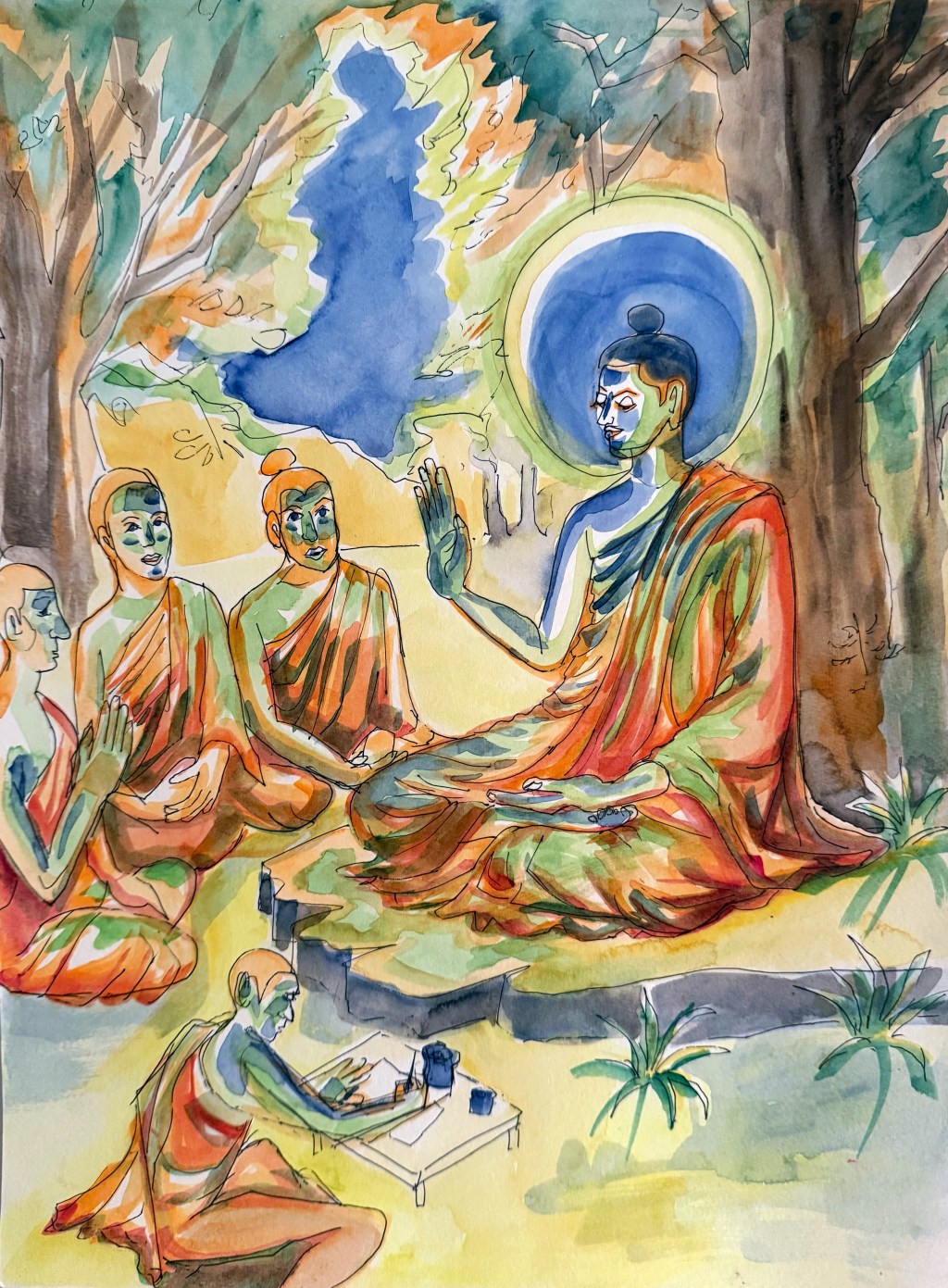
Among the disciples whose relics are traveling to Chicago this July, the Venerable Ānanda and the Venerable Vakkula represent two types of Dhamma practitioner: social and reclusive, respectively. Both inclinations have always found a home in the sangha, and both, when grounded in the Dharma, can lead to complete liberation. Venerable Ānanda and Venerable Vakkula were among the finest examples of each.
Venerable Ānanda — Foremost in Learning and Memory
Ānanda was the Buddha’s cousin and, for twenty-five years, his personal attendant. He began that role twenty years after the Buddha’s enlightenment and remained at his side until the end — carrying his robes, arranging his lodgings, managing the endless stream of people who came to hear the Dhamma, and listening to the Buddha’s words with unparalleled attentiveness.
His memory was extraordinary. He could recall, with complete accuracy, every word the Buddha had ever spoken in his presence — the setting, the occasion, the precise teaching given. Every sutta in the Pali Canon opens with the phrase evaṃ me sutaṃ — “thus have I heard” — and those words are Ānanda’s own. They are his declaration that what follows is what he received directly, held faithfully in memory, and recited at the First Buddhist Council after the Buddha’s passing. Without Ānanda, it is difficult to imagine how the Buddha’s teachings would have survived their first generation.
He was also the one who made the case for women to enter the monastic order. When Mahāprajāpatī Gautamī — the Buddha’s own foster mother — sought ordination and was initially refused, it was Ānanda who went to the Buddha on her behalf. The Buddha ultimately agreed. The bhikkhunī sangha — the order of nuns — exists in part because of Ānanda’s advocacy.
For all his gifts, Ānanda carried one difficulty throughout his monastic life: his deep emotional attachment to the Buddha. Profound love for one’s teacher is itself a fetter on the path, and Ānanda had not yet fully released it. At the time of the Buddha’s parinirvāṇa, Ānanda had not yet attained arhatship.
After the Buddha’s passing, the Venerable Mahākāśyapa moved to convene the First Buddhist Council to formally preserve and systematize the teachings. Ānanda was essential to this effort as no one else carried the breadth of what the Buddha had taught. But Mahākāśyapa set a condition: only those who had fully realized the fruits of the path could participate. Ānanda had not yet done so. In the days leading up to the council, Mahākāśyapa and others urged him on with great sincerity, knowing what was at stake. Ānanda threw himself into practice with complete urgency. On the eve of the council, having meditated through the night, final knowledge refusing to accede to his grasping, he finally gave up and lay down to rest.
At the very moment his head was about to touch the pillow, he attained full liberation.
He entered the assembly the next morning as an arahant and recited the entire body of the Buddha’s teachings from memory.
Ānanda’s life is a reminder that while even the most profound talents cannot secure liberation, even the most profound attachments can be overcome when one relinquishes all expectations and simply lets things be as they are. For 2,500 years he has been revered not only as the preserver of the Dharma but as the embodiment of the sangha’s warmth: the one who remembered everything, advocated for everyone, and kept the human heart of the tradition alive.
Venerable Vakkula — Foremost in Longevity and Freedom from Disease
The Venerable Vakkula is one of the most legendary figures in the early Buddhist sangha. He lived to one hundred and sixty years old. In eighty years of monastic life, he never experienced illness of any kind — not a headache, not a cold, not a single day of physical discomfort. He ordained at eighty and attained arhatship in seven days.
Vakkula’s legendary health is evident in his birth story. According to the traditional accounts, Vakkula’s stepmother, driven by jealousy, made five attempts on his life as an infant. He survived each one: thrown into boiling water, subjected to intense heat, cast into a river, swallowed by a great fish, and struck with a knife when the fish was later caught — the blade leaving him entirely unharmed.
The teachings on cause and effect point to his past lives as the source of his remarkable longevity and health. In a previous life he had offered a haritaki fruit to a sick pratyekabuddha. During the time of Kāśyapa Buddha, he gave medicinal herbs to the monastic community to cure their illnesses. Those acts of offering bore fruit across lifetimes in extraordinary vitality and freedom from disease.
The Venerable Vakkula led an incredibly disciplined life, wearing only tatters for robes, never dining in a house, and never allowing a sensual perception to arise in his mind. He taught no one and accepted no disciples. He spent his days in solitary meditation, entirely self-contained. The Buddha praised him as a model among the śrāvaka disciples for three qualities: his extremely long life, his freedom from illness, and his reticence. He passed away peacefully at one hundred and sixty, entering nirvāṇa as if entering meditative absorption.
Two Expressions of the Same Liberation
The Venerable Ānanda poured himself into the preservation of a teaching that would outlast him by millennia, which necessitated that he immerse himself among the people. The Venerable Vakkula turned entirely inward, leaving almost no trace except his realization and the extraordinary life that expressed it. Thus, we are reminded that in practicing the Dharma, there are as many ways to liberate oneself as there are sentient beings.
The relics of both Venerable Ānanda and Venerable Vakkula will be present at the Buddha and Sacred Relics Veneration and Prayer Ceremony this July in Chicago’s Chinatown. Next week we turn to the lineage that connects these ancient figures to our temple today — the story of Master Taixu, Master Yinshun, and the journey from Shanghai to Penang to Chicago’s Chinatown.
The ceremony takes place July 25–26, 2026. All are warmly welcome.
For official event details, visit ibfachicagotemple.org. To receive updates as the ceremony approaches, sign up here.
 IBFA Chicago | International Buddhism Friendship Association
Leave a comment