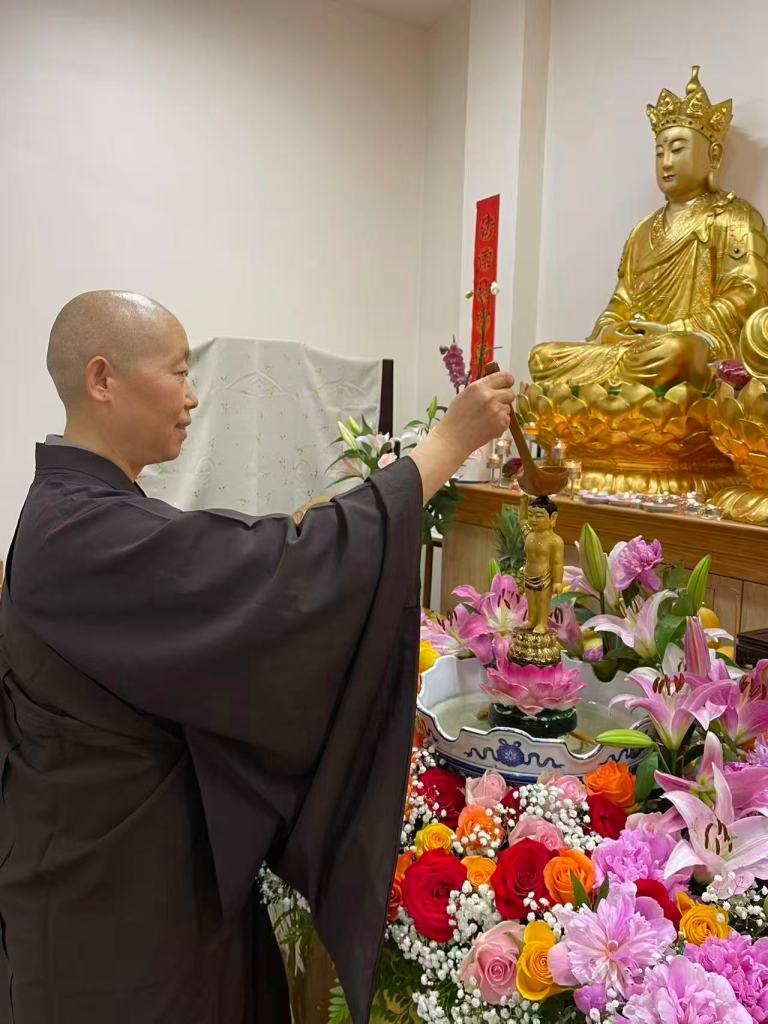
The five sacred relics coming to Chicago this July arrive from the Master Taixu Relic Stupa at Triple Wisdom Hall in Penang, Malaysia. Master Taixu was an indispensable figure in the revitalization of modern Chinese Buddhism, and his stupa in Malaysia enshrines, alongside the relics of the Buddha and his great disciples, the relics of three twentieth century Dharma masters. These modern Dharma masters shape our practice at IBFA profoundly.
Master Taixu — Reformer of Chinese Buddhism
Master Taixu (1890–1947) devoted his life to returning Chinese Buddhism to the spirit of the historical Buddha’s teachings. In his time, Chinese Buddhism had grown distant from systematic study and ethical cultivation and was too entangled with funeral rites and popular custom. He called for reform of monastic education, of the relationship between clergy and laity, and of Buddhism’s engagement with ordinary people in the present world.
The name given to Master Taixu’s movement is renjian fojiao, which translates to “humanistic Buddhism,” or “Buddhism for the human realm.” Rather than treating the Dharma primarily as a means of securing a favorable rebirth, Taixu taught that the cultivation of wisdom and compassion transforms human beings and, through them, the world they inhabit. Although he passed away in 1947 before seeing his reforms fully realized, the students he trained and the institutions he founded changed the direction of Chinese Buddhism for generations.
After his passing, Master Taixu’s relics were enshrined in stupas at several locations. Among the most renowned is the Master Taixu Relic Stupa at Triple Wisdom Hall in Penang.
Master Yinshun — Scholar of the Human Realm
Among all of Taixu’s students, Master Yinshun (1906–2005) built most substantially on his teacher’s foundation. Master Yin Shun spent his life studying the earliest Buddhist texts, including the Āgamas, the Pali Nikāyas, and the Madhyamaka treatises, to understand the core of the Buddha’s instructions prior to their obscuration by millennia of commentary and cultural syncretism.
According to Master Yin Shun, fidelity to the historical Buddha’s teachings allows for Buddhism to thoroughly re-engage with and improve the human world, as the Buddha of the Agamas and Nikayas was first and foremost teaching humans how to end human suffering. Master Yin Shun’s writings are central to how we understand and practice the Dharma at IBFA.
Master Yinshun lived to the age of ninety-nine, passing away in 2005. His relics rest in the stupa at Triple Wisdom Hall alongside those of his teacher.
Master Zhumo and Triple Wisdom Hall
Master Zhumo (1913–2002), a disciple of Master Taixu, was born in Zhejiang Province and in 1954 traveled south to Penang, where he founded the Triple Wisdom Hall. That same year, he presided over a Dharma assembly in Thailand to enshrine Master Taixu’s relics, and later brought them to Malaysia to establish the Master Taixu Relic Stupa, which was completed in 1972. When Master Zhumo passed away peacefully in Penang in 2002, over one hundred relics were recovered from his cremation.
Together, Master Taixu, Master Yin Shun, and Master Zhumo form a lineage of profound compassion, wisdom, scholarship, and action that reaches from ancient India to Chicago’s Chinatown. We are blessed to have the relics of these contemporary masters in our presence.
The Buddha and Sacred Relics Veneration and Prayer Ceremony takes place July 25–26, 2026 in Chicago’s Chinatown. The sacred relics will be open for public veneration throughout both days. All are warmly welcome.